
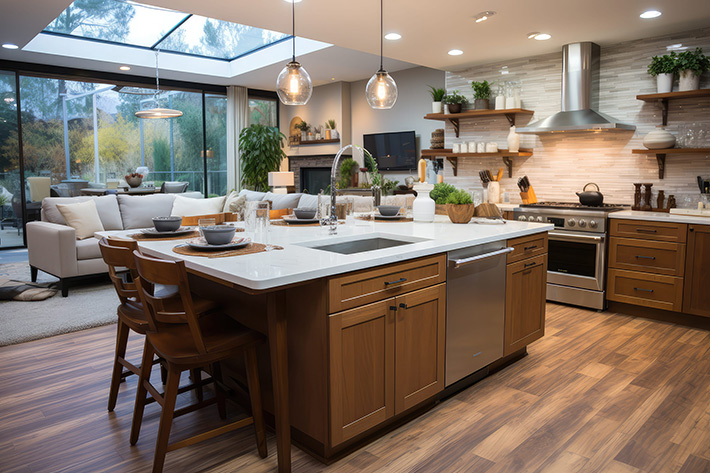
Kitchen islands are the heart of your kitchen, but they have to be done right. People want seating with comfortable knee room. You want a stylish look, but just how far can the countertop hang out past the cabinets before it needs support? With the right planning, you get comfortable seating and a clean look. Get it wrong, and you’ll need repairs on your stone counter when it cracks and breaks at weak points.
Why Countertop Overhang Support Matters
Stone is strong; with the right support, it can hold up an immense amount of weight and endure the test of time. With unsupported spans, it can crack and break with just the right amount of pressure in the wrong place.
Overhang problems usually don’t show up immediately. They show up later as a hairline crack near the cabinet line, a small separation at a seam, or a minor “bounce” that you can feel when you press down. Those are the kinds of issues that are easier to prevent than to fix.
What Changes the Strength of An Overhang
Here are the factors that determine whether you can go longer without support or should plan for brackets from the start.
Stone Type
Some stones are tougher in everyday use than others. Granite tends to be more forgiving than marble. Quartz is manufactured and generally consistent, but it can still crack if it’s poorly supported. Porcelain slabs are strong but require correct handling and support because they’re thinner.
The point is not “this stone is weak.” The point is that different materials behave differently under the same conditions, and your fabricator will treat them differently for good reason.
Thickness And Build-Up
Thicker edges add gravitas and physical strength, but they don’t make an overhang safe on their own. Many countertops have a thicker-looking edge, while the main field remains standard thickness. That can look great, but it doesn’t replace proper support if the span is long.
Shape And Cutouts
A straight rectangle can be supported more easily than a top with dramatic angles, curves, or narrow “wings.” Cutouts also matter. If your island has a cooktop, sink, or a large opening for accessories, that changes how the stone holds weight. A long overhang and a nearby cutout are a common combination that calls for careful planning.
What’s Underneath
The cabinet layout matters. A wide, stable base supports better than a narrow section or an open shelving layout. If there’s a dishwasher, wine fridge, or open knee space beneath, that affects where brackets can go and how much support the top can realistically get.
The Real-World Question: How Will People Use It?
This is where good design gets honest.
A breakfast bar used lightly by two adults is different from an island that becomes the family gathering spot, homework station, and party buffet. If people routinely lean on the edge, kids climb onto stools, or large groups gather on one side, that adds stress. Planning for that is not overkill. It’s just realistic.
Support Options That Keep the Look Clean
If you need support, you have several ways to do it without making the kitchen look like a rustic lodge.
Hidden Steel Brackets
These are some of the most common solutions for seating overhangs. They can be installed so they don’t intrude into knee space too much, and they keep the support where it belongs, under the stone.
Steel Plates Or Flat Bar Supports
For certain layouts, a continuous or semi-continuous support system can provide strength while staying visually minimal. This is often used when you want clean lines and don’t want decorative corbels.
Raised Walls Or Pony Walls
Sometimes, the simplest support is changing the cabinetry design. A small wall under part of the overhang can reduce the span and provide natural strength. This is especially useful on long islands where you want seating on one side but don’t need the same clearance across the entire length.
Decorative Corbels
Corbels still have a place, especially in traditional kitchens. They can be beautiful. They also take up more knee room, so they’re not always the best fit for tight seating layouts.
Planning Tips That Save Headaches Later
A few small decisions early on make the entire project smoother.
● Decide on stool spacing and comfort first. That tells you how much overhang you truly need.
● Confirm appliance locations, outlet locations, and any panels that require access before deciding on bracket placement.
● Do not make last-minute changes to overhang length after templating. That’s a common way small support gaps happen.
● If you want a dramatic overhang, discuss assistance before the cabinets are finalized. It’s much easier to build support in the early stages than to retrofit later.
The Bottom Line
A good overhang should feel boring in the best way. No flex. No worry. No “don’t lean there” comments when guests sit down. The cleanest-looking islands are almost always the ones that were planned with support in mind, even if you can’t see that support once the job is finished.
Beautiful Countertops Start with Expert Support and Installation
If your kitchen remodel includes an island or a peninsula with seating that looks right and feels rock solid, Wisconsin Granite Design can help you choose an overhang and support approach that fits your layout, your stone, and how you actually use your kitchen. From custom countertop design and stone selection to professional fabrication and installation of granite, quartz, marble, and more, our team makes sure your countertops are beautiful, functional, and built to last.